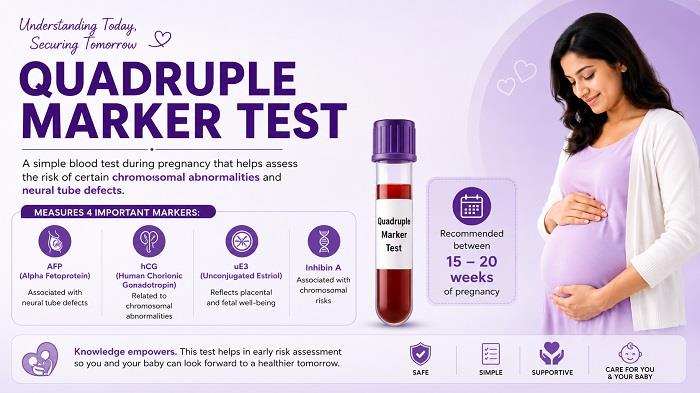
Quadruple Marker Test Pregnancy Guide
Pregnancy involves several important health screenings that help monitor both the mother and the developing baby. One such essential prenatal screening is the Quadruple Marker Test. This test helps assess the risk of certain chromosomal abnormalities and birth defects in the baby during the second trimester of pregnancy.
Although the test does not provide a confirmed diagnosis, it plays a crucial role in identifying pregnancies that may require further medical evaluation. Understanding the purpose and significance of this screening can help expecting parents make informed decisions during pregnancy.
What Is a Quadruple Marker Test?
The Quadruple Marker Test is a blood test usually performed between the 15th and 20th week of pregnancy. It measures the levels of four important substances in the mother’s blood:
- Alpha-fetoprotein (AFP)
- Human Chorionic Gonadotropin (hCG)
- Estriol (uE3)
- Inhibin-A
The levels of these markers are analyzed along with factors such as the mother’s age, weight, and gestational age to estimate the likelihood of certain fetal conditions.
Why Is the Quadruple Marker Test Done?
The main purpose of the Quadruple Marker Test is to evaluate the risk of chromosomal disorders and neural tube defects in the developing baby. This test helps screen for conditions such as:
- Down Syndrome
- Edwards Syndrome
- Neural tube defects like spina bifida
By identifying pregnancies at higher risk, doctors can recommend additional diagnostic tests if needed.
Who Should Consider This Test?
The Quadruple Marker Test may be recommended for all pregnant women as part of routine prenatal care. However, it becomes especially important for women who:
- Are above 35 years of age
- Have a family history of genetic disorders
- Had abnormal ultrasound findings
- Previously experienced pregnancy complications
- Have a higher-risk pregnancy
Early screening provides valuable information and allows doctors to plan further care if necessary.
How Is the Test Performed?
The procedure for the Quadruple Marker Test is simple and non-invasive. A small blood sample is collected from the mother’s arm and sent to the laboratory for analysis.
No special preparation or fasting is usually required before the test. The procedure itself takes only a few minutes, making it a convenient prenatal screening option.
Understanding the Results
The results of the Quadruple Marker Test indicate whether the pregnancy falls into a low-risk or high-risk category for certain fetal conditions.
A high-risk result does not necessarily mean the baby has a disorder. It simply suggests that additional testing—such as ultrasound, amniocentesis, or other genetic tests—may be recommended for confirmation. Similarly, a low-risk result reduces the likelihood of abnormalities but does not completely eliminate the possibility.
Benefits of the Quadruple Marker Test
One of the major benefits of this test is early risk assessment. It helps parents and healthcare providers identify potential concerns during pregnancy and make timely decisions regarding further care. Other advantages include:
- Non-invasive and safe for both mother and baby
- Helps detect risk of genetic and neural tube disorders
- Supports better pregnancy monitoring
- Provides reassurance when results are normal
Because it is a screening test, it is often used as part of a broader prenatal evaluation process.
Importance of Prenatal Screening
Prenatal screening plays an essential role in ensuring a healthy pregnancy journey. Identifying possible risks early allows doctors to offer better guidance, monitoring, and medical support throughout pregnancy.
Advanced diagnostic providers like Thyrocare Technologies Limited and Metropolis Healthcare offer prenatal screening tests with reliable laboratory support and timely reporting.
The
Quadruple Marker Test is an important second-trimester screening tool that helps assess the risk of chromosomal abnormalities and birth defects during pregnancy.
While it is not a diagnostic test, it provides valuable early insights that support informed medical decisions and improved prenatal care. Regular prenatal checkups and timely screening can help ensure a safer and healthier pregnancy for both mother and baby.